
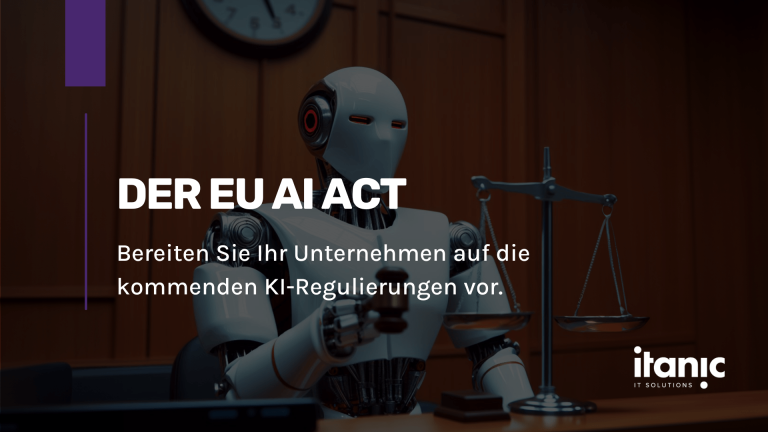
The EU AI Act: Challenges and Opportunities for Businesses
The upcoming EU AI Act sets new standards for the use and regulation of artificial intelligence (AI) in the European Union. As the world’s first comprehensive law of its kind, the AI Act presents both challenges and opportunities for businesses. What aspects should companies pay particular attention to?
Identification and Classification of AI Systems
Companies must accurately identify and classify their AI systems. This is crucial because the AI Act establishes different risk categories for AI applications. High-risk applications, such as those used in medical diagnostics or recruitment, are subject to strict regulations. Correct classification is essential for developing effective compliance strategies.
Adherence to strict compliance requirements
The AI Act imposes strict requirements on high-risk AI systems in areas such as data protection, transparency, and accuracy:
- Data privacy and data accuracy: The data used to train AI systems must be secure, representative, and unbiased.
- Transparency: Companies must ensure that the decision-making processes of their AI systems are traceable and explainable. This may require additional documentation and new methods of explanation.
- Monitoring and Reporting: Regular reviews and audits are necessary to ensure compliance with regulations.
Technical and organizational measures
Implementing "Privacy by Design" and "Privacy by Default" requires extensive technical and organizational adjustments. Companies may need to make significant changes to their systems in order to meet these requirements.
Training and Awareness
It is essential to train employees and raise awareness of the importance of AI compliance. Key personnel within the company must understand how the AI Act affects their work and what best practices to follow.
Global Impact and Market Positioning
Companies should not only focus on compliance within the EU, but also take into account the global implications of the AI Act. Since similar regulations are expected in other countries as well, it is important to develop an AI strategy that is scalable and compatible on a global scale.
Conclusion: Opportunities through proactive adjustments
The EU AI Act presents companies not only with challenges but also with an opportunity to position themselves as leaders in the field of ethical AI applications. By proactively adapting and complying with the regulations, companies can minimize legal risks while strengthening customer trust.